
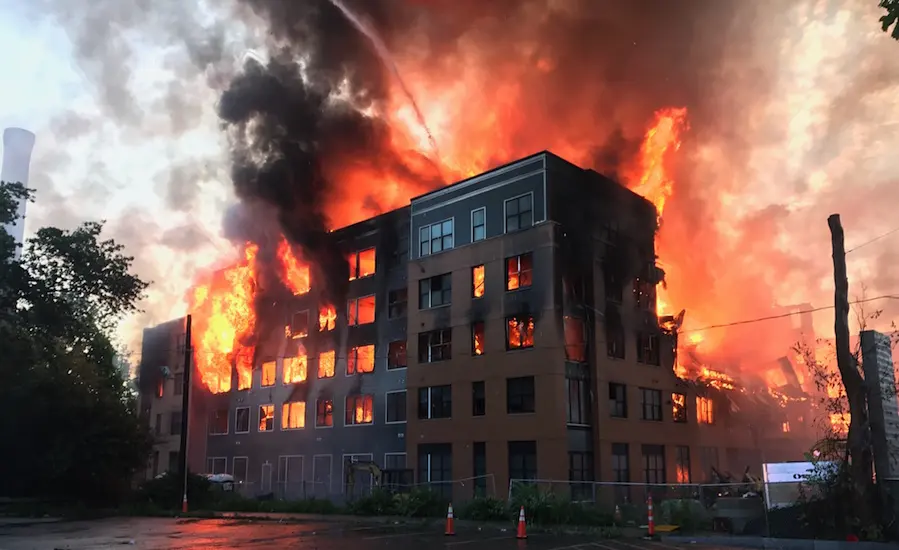
The true cost of a major fire could be far greater than we think.
Are businesses really prepared for the changing consequences of fire?
Recent research has highlighted a worrying situation concerning insurance cover across the UK.
According to RebuildCostASSESSMENT.com’s 2026 research, based on 46,917 property assessments, 67% of the buildings assessed were underinsured, with just 8% insured for the correct reinstatement value.
These findings should concern everyone involved in property management, insurance, fire safety and business continuity.
However, I believe there is a much wider issue that deserves greater attention within the fire safety industry.
The risks associated with fire are changing, and so are the financial and environmental consequences.
Having worked in fire safety and risk management for over 30 years, I have seen considerable changes in how buildings are constructed, occupied and used.
We are now dealing with risks that were either less prevalent or simply not considered to the same extent two or three decades ago.
Yet I question whether businesses fully appreciate the potential consequences of a serious fire, particularly when it comes to insurance and their ability to recover.
The Changing Nature of Fire Risk
Consider some of the changes we are seeing across commercial and industrial premises.
Lithium Ion Batteries and Emerging Technologies
Lithium-ion batteries (LIBs) are becoming increasingly common throughout our buildings.
From electric vehicles, forklift trucks and battery-powered equipment to large-scale battery energy storage systems, these technologies are changing the fire risk profile of many premises.
Although the risks vary considerably according to battery chemistry, design and application, thermal runaway can introduce significant challenges, including intense fire development, hazardous gases and the potential for further ignition.
These incidents may also present additional challenges for firefighting operations, environmental protection and subsequent recovery.
Are insurers and businesses keeping pace with these changes, particularly where substantial quantities of batteries are being stored, handled or charged?
Changes in Storage and Fire Loading
Modern warehouses are another area of concern.
The growth in logistics, online retailing and distribution has resulted in significant changes to storage arrangements.
We are seeing higher storage densities, increased quantities of combustible packaging, plastics and other materials, together with changing stock profiles.
Such changes can significantly influence fire development, the potential scale of a fire and the effectiveness of existing fire protection measures.
A warehouse that was appropriately protected when originally constructed may not necessarily offer the same level of protection following substantial changes in its operation or storage arrangements.
These changes need to be reflected in fire risk management, property protection and insurance reviews.
The Environmental Consequences of Fire
This is an area particularly close to my own professional research.
When discussing the consequences of a major industrial or commercial fire, we naturally consider structural damage, loss of stock, equipment and the impact on employees.
However, what about the environmental consequences of firefighting operations?
A substantial fire may require significant quantities of firefighting water.
Once that water comes into contact with burning materials, chemicals, plastics, metals, oils and other substances, it can become heavily contaminated.
Depending on the nature of the site and the materials involved, contaminated firefighting water can enter drainage systems, surrounding land and nearby watercourses.
The consequences can extend well beyond the boundaries of the affected premises.
Following a serious fire, an organisation may face:
The containment, collection and treatment of contaminated firefighting water.
Removal and specialist disposal of contaminated fire debris.
Environmental sampling and investigation.
Remediation of contaminated land or drainage systems.
Potential regulatory action and associated liabilities.
Extended delays before the site can be safely reoccupied.
These costs can be substantial, particularly at industrial and high-storage premises.
Yet how many businesses have considered these exposures when reviewing their insurance arrangements?
And, perhaps more importantly, how many have established whether their policies actually provide adequate environmental clean-up and pollution liability cover?
Not all policies provide the same protection, and businesses should never assume these costs will automatically be covered.
Underinsurance Could Make a Serious Fire Financially Devastating
Many property owners still confuse the market value of a building with its reinstatement cost.
They are two very different figures.
Reinstatement can involve considerably more than rebuilding the structure.
Demolition, debris removal, professional fees, specialist materials, updated building requirements and other associated costs may all need to be considered.
Where insurance includes a condition of average, underinsurance may also result in a proportionate reduction in a claim, even when the building has suffered only partial damage.
Consider a simple example.
A building has an actual reinstatement value of £3 million but is insured for £2 million.
A fire causes £600,000 of insured damage.
If the policy’s average clause applies proportionately, the insurer could reduce the settlement to approximately £400,000, before any applicable excess or other policy adjustments.
The business would potentially face a £200,000 shortfall.
Now consider the consequences if the same incident also involves environmental contamination, destroyed machinery, loss of stock and several months of business interruption.
The financial exposure could become considerably greater.
Business Continuity and the Ability to Recover
One of my longstanding concerns is that businesses sometimes focus too heavily on meeting minimum fire safety requirements without giving sufficient attention to the consequences of a major incident.
Let me be clear.
Life safety must always remain our first priority.
The statutory fire risk assessment under the Regulatory Reform (Fire Safety) Order 2005 in England and Wales is primarily concerned with protecting relevant persons from fire.
However, protecting life and protecting the future of a business are not mutually exclusive objectives.
A business may successfully evacuate everyone from a building and still face a catastrophic financial loss.
Even where insurance is adequate, there may be considerable delays associated with investigations, environmental remediation, rebuilding, replacement machinery and restoring business operations.
Customers may find alternative suppliers. Contracts may be lost. Employees may need to be retained while the business is unable to operate.
Business interruption insurance can provide essential protection, but the adequacy of the insured amount, policy coverage and maximum indemnity period all need careful consideration.
A business that anticipates being operational again within six months may discover that full recovery takes considerably longer.
For some organisations, the consequences may be enough to prevent them from reopening.
Should the Fire Safety Industry Be Doing More
I believe we should.
As fire safety professionals, our primary responsibility in statutory fire risk assessments is protecting people.
However, we are also in a position to raise awareness of the wider consequences of fire.
Where appropriate, we should be encouraging clients to consider:
Property protection: Are existing precautions appropriate for the current use, storage arrangements and fire loading?
Emerging risks: Have lithium-ion batteries, electrical storage systems and other new technologies been properly considered?
Environmental protection: Could firefighting water or fire debris cause significant contamination, and are suitable containment arrangements necessary?
Insurance adequacy: Has a competent professional undertaken a current reinstatement cost assessment, and have machinery, plant, equipment and stock values been reviewed?
Business interruption: Would the organisation have sufficient financial protection to survive an extended period of closure?
Recovery planning: Is there a realistic, tested business continuity plan that considers the full consequences of a serious fire?
These matters require input from competent fire safety professionals, insurers, brokers, property surveyors and environmental specialists.
A conventional life-safety fire risk assessment is not a substitute for these specialist reviews.
My Final Thoughts
The fire safety industry has made considerable progress in improving standards, legislation, professional competence and awareness.
However, the consequences of fire are not standing still.
New technologies, changing storage arrangements, increasingly complex buildings and environmental considerations are creating challenges that require a broader approach to risk management.
We must continue to prioritise life safety, but we should also be encouraging organisations to consider property protection, environmental consequences and business resilience.
The 2026 underinsurance findings should act as a warning.
There is little comfort in discovering that a building was seriously underinsured only after a major fire has occurred.
A successful evacuation may save lives, but without adequate fire protection, insurance and business continuity arrangements, the business itself may not survive.
Perhaps it is time we gave the wider consequences of fire the same level of attention they deserve.
