
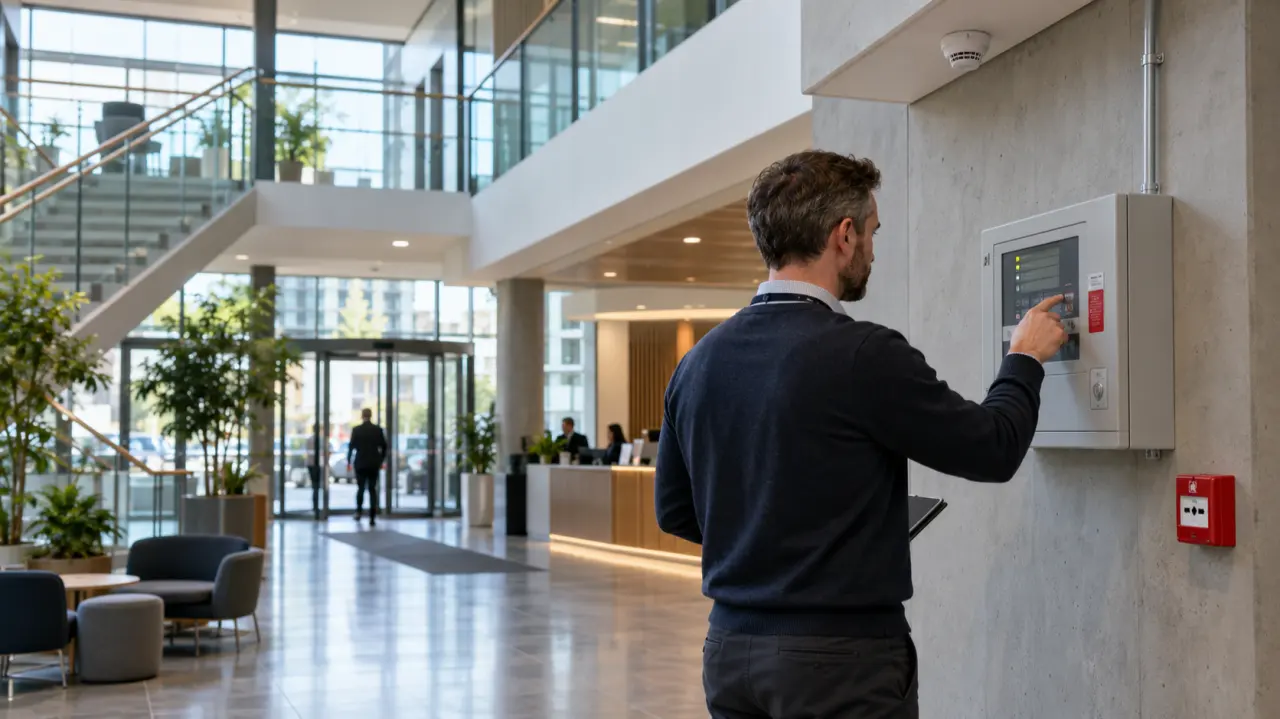
When we consider active fire safety systems within modern buildings, considerable emphasis is placed on fire detection, alarm systems, smoke control, suppression and other protective measures.
However, one of the most important aspects of how these systems operate is their cause-and-effect arrangements.
In simple terms, cause and effect determines how a building responds when a particular fire safety device is activated.
Depending on the building’s fire strategy, the activation of a detector may initiate a sequence of operations involving fire alarms, smoke control systems, ventilation equipment, fire door release mechanisms, access control systems and lifts.
In more complex buildings, these arrangements can be extensive, particularly where phased evacuation, multiple occupancies or sophisticated smoke management systems are involved.
The successful operation of these systems relies not simply on individual components functioning correctly, but on their interaction, timing and ability to respond in accordance with the building’s fire strategy.
This is something we believe deserves considerably more attention.
But with the rapid development of AI, are we approaching a fundamental change in how buildings detect and respond to fire?
Traditionally, cause-and-effect systems have operated through predefined instructions. A detector activates, the control equipment identifies the signal, and the programmed sequence of operations follows.
Modern systems can already provide sophisticated control arrangements, but their responses are generally determined by established programming rather than independent interpretation of developing conditions.
AI could potentially introduce a different dimension.
Imagine a large commercial building where information is continuously gathered from temperature sensors, smoke detection equipment, environmental monitoring, thermal imaging and other connected building systems.
Rather than simply waiting for a detector to reach its operating threshold, AI could potentially analyse changes across several sources and identify patterns associated with developing fire conditions.
A gradual but unusual increase in temperature, accompanied by changes in air quality or other environmental indicators, might be recognised as a developing concern before conventional fire alarm conditions are reached.
This does not necessarily mean a fire has occurred. However, it could provide an opportunity for building management to investigate an emerging problem before it escalates.
This is where we believe the real potential lies: moving beyond reactive fire safety towards predictive fire safety intelligence.
We already have technology capable of monitoring plant performance, identifying abnormal operating conditions and providing increasingly sophisticated diagnostics.
The question is how these capabilities might develop alongside established fire detection and cause-and-effect systems.
Could AI eventually recognise the early characteristics of an electrical fault, overheating equipment or developing combustion before conventional detection equipment activates?
Could it identify deterioration within smoke control equipment, fire detection components or other critical systems before that deterioration results in failure?
Could it analyse information from multiple building systems and provide emergency responders with a clearer picture of developing conditions?
These are realistic areas for further technological development, although their reliability and effectiveness would need to be demonstrated in actual building environments.
There is also the possibility that AI could support more detailed assessments of how fire conditions might develop within a building, providing information to assist emergency management decisions.
However, this introduces an important distinction.
At what point does predictive building monitoring become part of a safety-critical fire detection and control system?
An AI system identifying abnormal conditions and alerting building management is one thing.
Allowing an algorithm to independently modify evacuation arrangements, suppress fire alarm signals or alter smoke control operations is something entirely different.
Any system influencing life safety functions must demonstrate appropriate reliability, predictable operation and compatibility with the building’s fire strategy.
We cannot simply assume that because AI can process information more quickly or recognise complex patterns, it will necessarily make safer decisions.
False indications remain a concern, but perhaps more importantly, what happens if an AI system fails to recognise a genuine developing fire?
How would such systems respond to unfamiliar conditions, incomplete information, component failure or loss of network connectivity?
Would they continue to operate safely if their software or communications were compromised?
And who would ultimately be responsible for validating the decisions being made?
These questions require consideration before AI is permitted to exercise greater control over essential fire safety functions.
British Standards already provide an established technical framework for conventional systems.
BS 5839-1:2025 addresses the design, installation, commissioning and maintenance of fire detection and fire alarm systems in non-domestic premises.
BS 7273-4:2015+A1:2021 addresses the operation of release mechanisms for doors, while BS EN 54-13:2017+A1:2019 establishes requirements for assessing compatibility and connectability between fire detection and alarm system components.
The BS EN 12101 series is also relevant to smoke and heat control systems.
However, the increasing integration of AI raises wider questions about validation, software control, cybersecurity and the management of changes throughout a building’s operational life.
We suspect these issues will become increasingly important in future technical guidance and standardisation.
There is also an important consideration for those of us undertaking fire risk assessments.
When assessing complex commercial buildings, do we always give sufficient consideration to the cause-and-effect arrangements and whether these remain appropriate?
A building may have a functioning fire alarm system, smoke control equipment, electronically controlled fire doors and other active protective measures.
But do we have sufficient evidence that they interact correctly?
Has the original cause-and-effect matrix been retained and updated?
Have alterations to the building, changes in occupation or refurbishment works affected the original arrangements?
And has the integrated operation of the systems been adequately verified?
These questions are already relevant without introducing AI.
As buildings become increasingly connected and automated, I believe the importance of understanding their overall fire safety architecture will only increase.
There is a distinction between verifying that individual components have been maintained and establishing that the complete system will operate as intended during a fire.
Neither a sophisticated fire alarm panel nor intelligent software can compensate for an incorrectly designed, undocumented or inadequately tested cause-and-effect arrangement.
Our view is that AI has the potential to make a significant contribution to fire safety, but its initial value may lie in improving the intelligence surrounding established safety-critical systems.
Predictive monitoring, earlier identification of abnormal conditions, enhanced fault diagnostics and improved information for building management could all contribute to better fire safety outcomes.
The essential protective functions, however, must continue to be based on sound fire engineering principles, appropriate technical standards and demonstrable performance.
Having worked in fire safety for more than 30 years, we have witnessed considerable technological advancement. We suspect the next decade could introduce developments that fundamentally change how we monitor and manage fire risk within complex buildings.
But technological advancement must be accompanied by equally robust arrangements for design, testing, maintenance and independent assurance.
Perhaps the most important question is no longer whether AI will become part of our buildings’ fire safety systems.
It is whether the fire safety profession, manufacturers and those responsible for developing technical standards are sufficiently prepared to manage the transition from reactive systems towards predictive intelligence.
